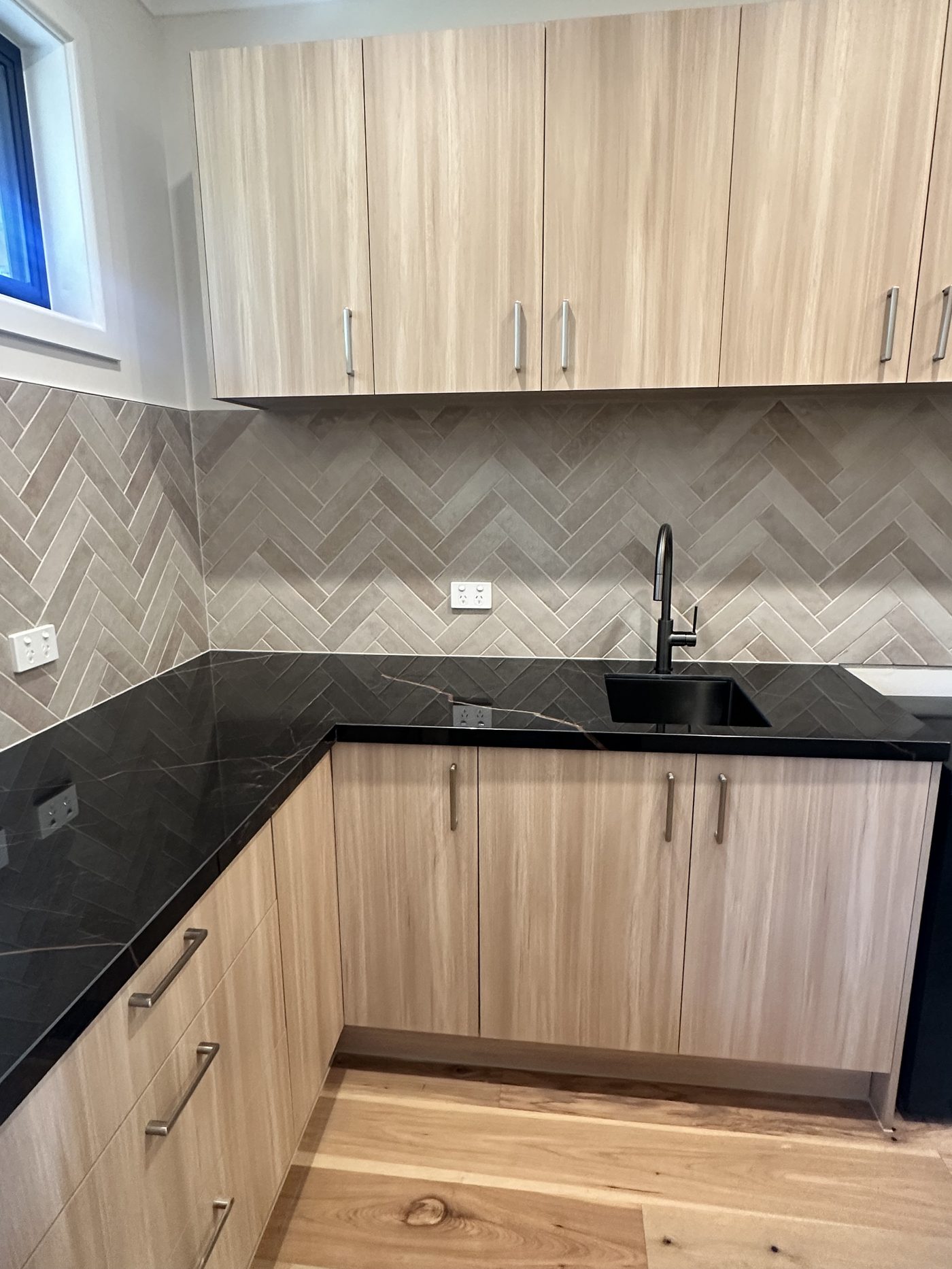
Thermolaminate (also called vinyl wrap or thermofoil) is a PVC film applied under heat and pressure to a pre-shaped MDF substrate — and it's the dominant door finish used in Australian kitchens today. Not because it's the cheapest option (it isn't always), but because it delivers a genuinely excellent result for most residential applications. Understanding exactly what it is and where its boundaries sit helps you specify it with confidence.
How thermolaminate is made
The manufacturing process defines the product. A moisture-resistant MDF door blank is profiled (routed) to the desired shape, then a PVC film is applied in a heated press that conforms the vinyl precisely to every curve, profile, and detail in the door face and edges. The result is a seamless, fully-wrapped surface — no exposed substrate on any edge or profile. This is what separates thermolaminate from laminate (which is flat and has a separate applied edge strip).
The PVC film used today is substantially heavier gauge and more heat-tolerant than the vinyl doors of the 1990s. Modern thermolaminate can withstand ambient temperatures up to around 70–80°C — more than adequate for a kitchen cabinet, provided the door isn't adjacent to a heat source without adequate spacing.
Thermolaminate wraps the entire door face and edges in one continuous film — including profiles, curves, and routed details. This is what enables the shaker, Hamptons, and decorative profiles that define the look of most Australian mid-range kitchens. A flat laminate product cannot achieve this; 2-pac achieves it but at higher cost.
Finishes and textures
The range of finishes available in thermolaminate has expanded significantly. The major categories used in Australian kitchens:
| Finish | Sheen level | Best for | Maintenance notes |
|---|---|---|---|
| Smooth matt | Low (5–15°) | Contemporary, minimalist | Shows marks less, easy wipe-clean |
| Gloss | High (70–90°) | Modern, high-impact | Shows fingerprints, scratches visible |
| Woodmatt / Woodgrain | Low-medium | Timber-look, coastal, warm modern | Grain hides minor marks well |
| Texture / Ashgrain | Low | Industrial, earthy, tactile | Grain texture hides wear effectively |
| Ravine | Low-medium | Contemporary timber, feature panels | Deep grain — excellent wear disguise |
| Natura | Very low (3–8°) | Premium matt, stone-touch feel | Ultra-soft feel, most fingerprint-resistant |
Door profiles available in thermolaminate
One of thermolaminate's key advantages is the ability to wrap profiled door shapes — enabling shaker, Hamptons, and decorative styles at semi-custom pricing. The profile is routed into the MDF substrate before wrapping:
- Flat (Style 1) — simplest profile, no routed detail. Used for contemporary handleless designs.
- Shaker profiles (Style 2–4) — recessed panel with frame rail. Rail width varies from tight/contemporary to wide/traditional.
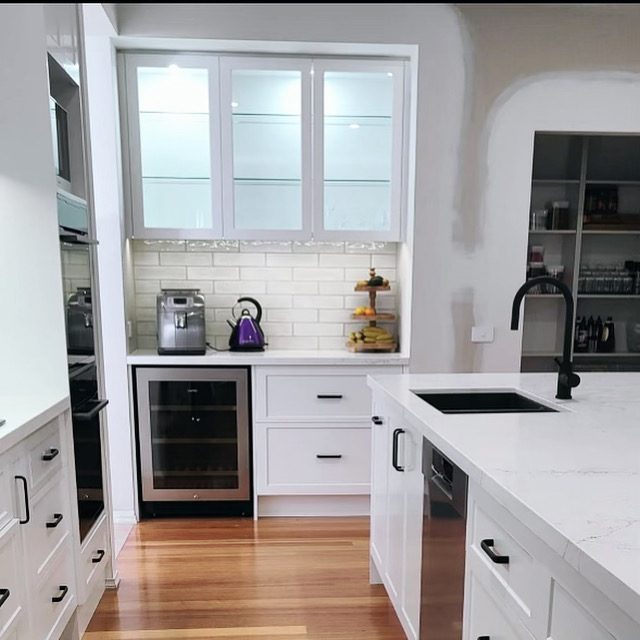
- Hamptons profiles (Chifley, Sussex, Hampton, Ascot) — shaker-adjacent with small bevelled edge detail. Various rail widths.
- Feature profiles (Cove, Peak, Calcutta, Malabar) — textural and architectural details. V-grooves, flutes, angled peaks.
Thermolaminate vs 2-pac: when each wins
| Factor | Thermolaminate | 2-pac polyurethane |
|---|---|---|
| Cost (supply, medium kitchen) | $4,000–$9,000 | $7,000–$16,000 |
| Surface hardness | Good | Excellent |
| Profile capability | Full (curved, shaped) | Full (spray-applied) |
| Colour range | Very wide (manufacturer ranges) | Unlimited (any paint colour) |
| Custom colour match | Limited to range colours | Yes (Dulux, Colorbond etc) |
| Touch-up/repair | Cannot be repainted | Can be touched up or resprayed |
| Edge quality | Seamless wrap (no edge strip) | Smooth, spray-applied |
| Lead time | 4–8 weeks | 6–10 weeks |
| Best suited to | Mid-range renos, profiled doors | Premium renos, exact colour match |
For profiled door styles (shaker, Hamptons) in a mid-range renovation, thermolaminate is the smart choice — it delivers the profile with no edge seam at significantly lower cost than 2-pac. If exact colour matching to another element (paint colour, tapware, tiles) is critical, 2-pac is the better option since thermolaminate is limited to the manufacturer's colour range.
What makes a quality thermolaminate door
Not all thermolaminate doors are equal. The quality variables to look for:
- Substrate grade — moisture-resistant E-Zero MDF is the correct substrate for kitchen doors. Standard MDF is not moisture-resistant and can swell near sinks and dishwashers.
- Film gauge — thicker vinyl film (0.3mm+) provides better durability and edge definition on profiled doors. Entry-level products use thinner film that can lift at corners under heat and moisture.
- Profile sharpness — quality thermolaminate wraps cleanly into tight profile corners. Poor product leaves visible air bubbles or rounded-off profile edges on shaker rails.
- Manufacturer — specify by brand (polytec, Laminex, Porta) rather than accepting unbranded "quality European vinyl" from suppliers who don't name the product.
Frequently asked questions
No. The PVC film surface does not accept paint adhesion reliably. If a thermolaminate door is damaged and the colour needs changing, the door needs to be replaced — not painted. This is one of the key differences from 2-pac, which can be sanded and resprayed. If future flexibility to change colour matters to you, 2-pac is the better investment.
Modern thermolaminate is heat-tolerant to around 70–80°C ambient temperature — sufficient for normal kitchen use. The risk area is a cabinet directly adjacent to an oven or dishwasher vent without adequate spacing. Ensure your cabinet maker maintains minimum clearances (as per appliance manufacturer specifications) for any cabinet next to a heat-producing appliance. Quality product with correct installation does not peel under normal conditions.
The same product — thermolaminate, vinyl wrap, and thermofoil are all names for the same process of heat-pressing PVC film onto a profiled MDF substrate. "Vinyl wrap" was the more common industry term in the 1990s–2000s; "thermolaminate" is now the dominant trade term in Australia. "Thermofoil" is more common in the US market.
Quality thermolaminate doors on MR-MDF substrate with correct installation typically last 15–20 years in normal residential use. The primary failure modes are: edge lifting near persistent moisture (poorly sealed substrate), UV yellowing on white gloss in north-facing sun exposure (use UV-stable product in these applications), and surface scratching on high-gloss finishes in heavy-use kitchens.