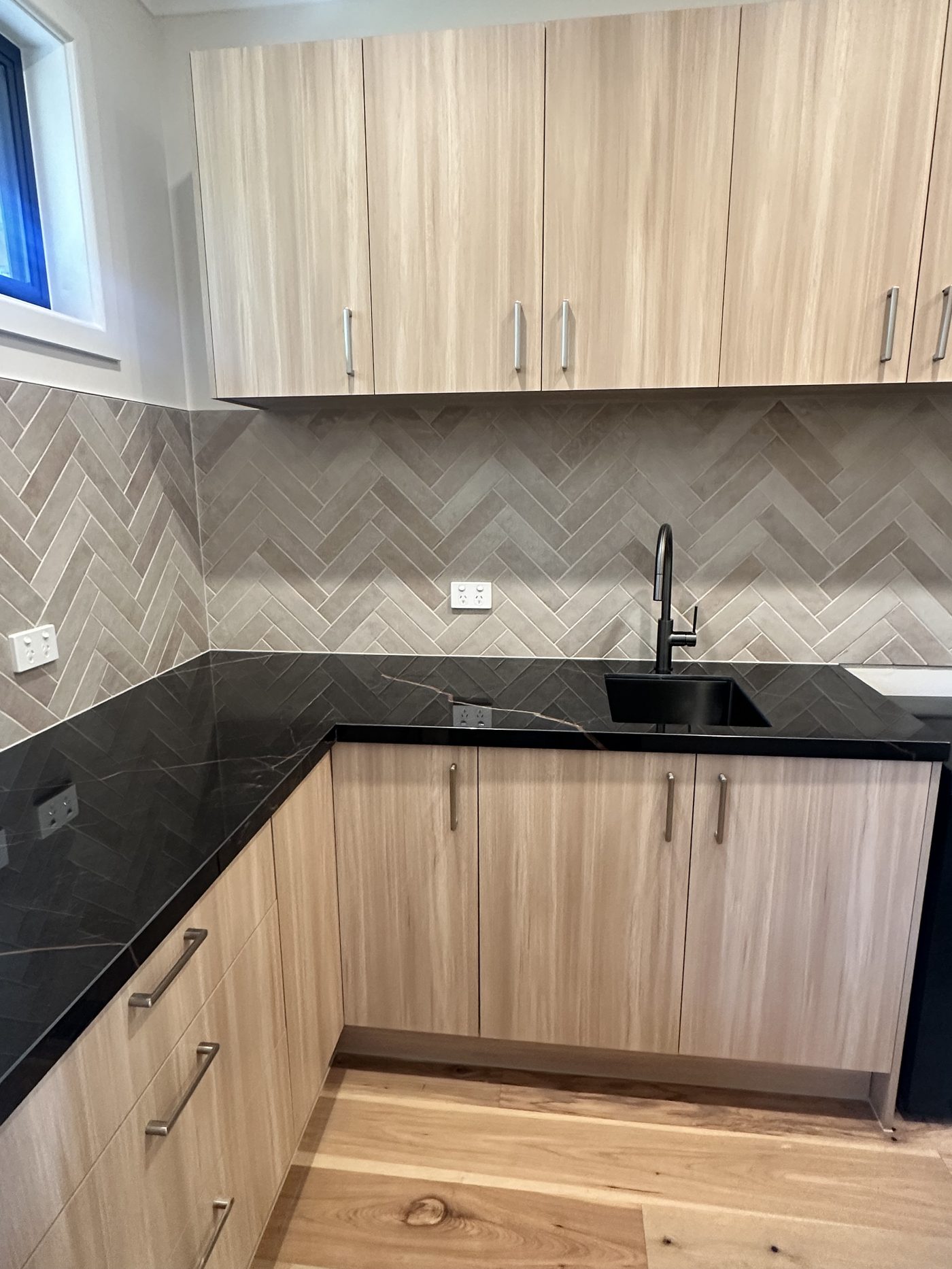
The galley kitchen has a reputation problem. Most people associate it with small apartments and builder-grade fitouts — but commercial kitchens, which prioritise function over almost everything else, are almost universally galley-format. The workflow efficiency of two parallel runs facing each other is genuinely superior to any other layout. The design challenge is not the layout itself but how to make it look and feel considered rather than utilitarian.
Why galley kitchens work
The work triangle — sink, cooktop, and refrigerator — is the foundation of efficient kitchen design. In a galley layout, this triangle can be set up with minimal movement: sink and cooktop on one run, refrigerator and preparation surface on the other. Every step you take during cooking is purposeful rather than wasted. This is why professional kitchens overwhelmingly use parallel-run layouts.
Minimum and ideal dimensions
The critical measurement is the clearance between facing cabinet runs: 900mm is the absolute minimum for a functional galley. 1,000–1,100mm is comfortable for one person and allows a second person to pass. Over 1,200mm and the galley starts to lose its efficiency advantage — too much distance between the two working surfaces. If you have more than 1,200mm between runs, consider a different layout or an island configuration.
The 900mm minimum is to the face of the cabinet, not the wall. If you have a dishwasher that opens into the walkway, 900mm clearance with the dishwasher closed becomes 600mm with it open — a real problem. Account for appliance doors in your clearance measurement.
Making a galley feel spacious
The main design challenge is avoiding the corridor feeling. Strategies: run the kitchen into the view (a window at one end rather than a wall), use consistent cabinetry on both runs without too much variation, keep the splashback simple and consistent, use ceiling-height cabinetry on one side to make the run feel intentional rather than low, and maximise light with under-cabinet lighting on both sides.
Single-ended vs through-access
A galley kitchen with one closed end and one open end (the most common configuration) is slightly more efficient than a through-access galley (open at both ends) because there's no through traffic interrupting the workflow. Through-access galleys are common in open-plan homes and work well, but require consideration of which end connects to the living area and which to the service areas of the house.
Storage in a galley kitchen
Galley kitchens typically have excellent storage per square metre, because both runs are used for cabinetry — there are no corners, islands, or wasted spaces. Extending upper cabinets to ceiling height maximises this advantage. Appliances that recess into the cabinetry line (integrated fridge, integrated dishwasher) maintain the clean parallel visual that makes galley kitchens read well.
Frequently asked questions
For cooking, yes — it's the most efficient layout. For entertaining while cooking, it's less ideal because guests can't easily be nearby without being in the workflow. If entertaining while cooking is important, a galley with an island or peninsula that guests can gather at is the best solution.
3–5 metres per run is the functional sweet spot. Shorter and storage becomes constrained. Longer and you start walking too far between elements. A 4-metre galley with two runs at 900mm clearance and ceiling-height uppers is an excellent kitchen.
Only if you have enough space. An island needs 1,000–1,100mm clearance on all working sides. In a narrow galley, adding an island reduces workflow clearance to impractical levels. In a wider galley (corridor over 2.8m wide), an island can work.
Better task lighting (under-cabinet LED strips on both sides), clear the counters as much as possible, and update handles and tapware. The visual effect of a galley kitchen depends heavily on light and order — these changes can have a significant impact at low cost.